For candidates
Winter at work: dark mornings, frost and getting to your shift

KONO

05.11.2026

6 min. reading
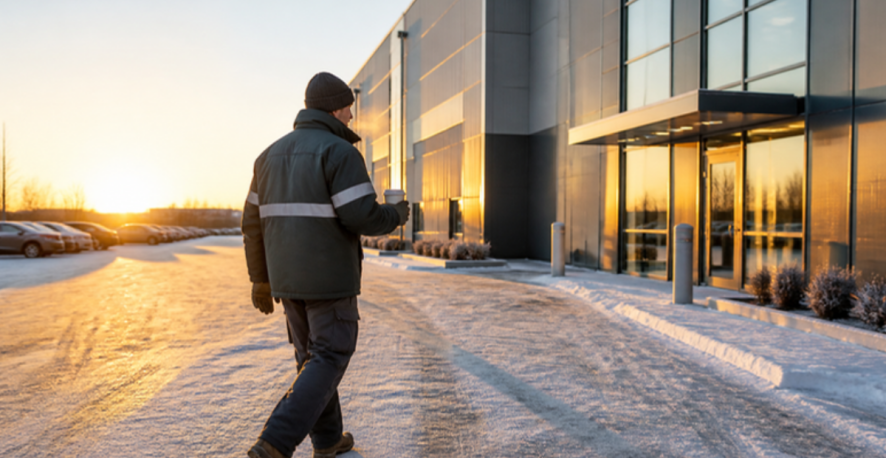
In November and December you travel to work in the dark and come home in the dark. On a shift starting at 6:00 you mostly see the sun through the factory window, and after an afternoon shift it is already night. On top of that come frost, slippery bus stops and buses that get cold in traffic jams.
With good preparation, winter at work really is not that scary. Below is what is worth knowing about daylight, commuting and clothing, especially if you work in a warehouse or in production.
Spis treści
How much daylight do we have in winter?
In November the day gets shorter week by week, and the shortest is 21 December. In Warsaw it then lasts about 7 hours 40 minutes.
| City | 10 November: sunrise / sunset | 21 December: sunrise / sunset |
|---|---|---|
| Warsaw | 6:47 / 15:51 | 7:43 / 15:24 |
| Wrocław | 6:59 / 16:10 | 7:53 / 15:46 |
| Iława | 6:58 / 15:52 | 7:56 / 15:22 |
The times are approximate (astronomical calculations, Central European Time) and differ by a few minutes depending on the location. The conclusion is simple: if you start work before 7:00 or finish after 16:00, you travel there and back in the dark. We wrote about how the clock change affected work and well-being in a separate article.
Getting to your shift in winter
Winter adds a few things to the commute that you do not have in summer: ice, snow, scraping windows and longer waits at the stop. Leaving yourself extra time helps the most.
- Leave earlier. Allow 15–20 extra minutes for clearing snow, slippery pavements and delays. Being late because of snow counts in the schedule just the same.
- If you walk after dark, wear something reflective. In Poland, a pedestrian walking on a road outside a built-up area after dark must wear reflective elements. A band on your sleeve or backpack is enough, and it really does raise the chance that a driver will see you.
- On a bike: lights and reflectors. A white light at the front and a red one at the back. In winter you ride slower and brake for longer.
- By car: tyres and windows. Winter tyres are not compulsory in Poland, but they are recommended when the average daily temperature drops below 7°C. Summer tyres harden in the cold and lose grip. An ice scraper and winter washer fluid will also come in handy.
- Share the ride. If you live with colleagues or in the same area, agree on a shared car or transport. In winter it is more comfortable and cheaper.
- Check the timetable. Buses and trains can run late in winter. On public holidays they run less often, so check the departure times before a shift on a day off.
Frost in the hall, the warehouse and outdoors
Warehouses and production halls are not always warm. Doors open, goods arrive from the frost, and some halls are not heated at all. That is why winter work clothing matters.
- Dress in layers. Warm underwear, a fleece, a warmer jacket. You can take layers off when it gets warm and put them back on when you need to.
- Hat, gloves, warm socks. Fingers and toes get cold fastest. It is worth keeping a spare pair of socks and gloves.
- Work boots with some room. Boots that are too tight, worn with thick socks, squeeze your foot and get cold faster. Choose a size where your toes have a little space.
- Change wet clothes. Wet gloves and socks chill you faster than damp air. Put spares in your backpack.
- A flask with a hot drink. Hot tea during a break makes a difference, especially in a cold store and outdoors.
- Ask about protective clothing. Many workplaces provide insulated work clothing in winter or a warm room for breaks. Ask your coordinator what is available at your workstation.
If you start to shiver, lose feeling in your fingers or feel unusually sleepy, tell your foreman and take a break somewhere warm. When working in the cold, it is better to react early.
Dark mornings and focus at work
In winter many people find it harder to get up, and sleepiness shows up during the day. That is normal: the days are short, and darkness affects sleep and mood. When you work with machines and forklifts or in a warehouse, focus matters, so it is worth looking after yourself:
- after leaving home, try to spend a little time in daylight, even on a short walk,
- stick to a regular sleep routine and do not drink energy drinks right before a shift,
- go outside during your break if you can,
- eat warm meals, not just sandwiches from the fridge.
5 practical winter tips
- Get up 20 minutes earlier. A time buffer reduces stress when something goes wrong.
- Pack a shift kit. Spare gloves, socks and a hat in your backpack or locker.
- Wear something reflective. A reflective band costs a few zlotys and works like a torch.
- Save your coordinator’s number. If the bus does not come or snow blocks the road, call before the shift, not after it.
- Bring a hot drink and food. A flask and a warm lunch in a container are the simplest way not to freeze on your break.
Frequently asked questions about winter work
When does it get dark in Poland in winter? In mid-November around 15:50, and in December around 15:20–15:30. In the morning, the sun rises in December only after 7:40.
Are winter tyres compulsory in Poland? No, but they are recommended when the average daily temperature drops below 7°C. Tyres must be in good condition, including a tread depth of at least 1.6 mm.
Do I have to wear reflective elements? A pedestrian walking on a road outside a built-up area after dark should have reflective elements. In town on the pavement there is no such obligation, but a reflector helps anyway.
What if I cannot get to work because of snow or a breakdown? Call your coordinator as early as possible, ideally before the shift starts, and say when you can be there.
Will I get warm clothing at work in winter? It depends on the workplace and the position. Ask your coordinator before your first day what is provided.
Looking for a job in Poland?
KONO helps you find legal work in Poland in warehouses, production and retail, with a clear schedule and the support of a coordinator. Browse the current job offers or message us on Instagram with the word “РОБОТА” (“work” in Ukrainian).
Recruitment is carried out by HR Kadra Sp. z o.o. · KRAZ certificate no. 34314.
KONO
KONO is a team that shares its knowledge on our blog. We hire employees from all over the world and take care of the individual needs of our clients.
Our publications are timely, substantive and aimed at both employers and employees.
At KONO, we focus on people and share our experience to support the professional development of our readers.